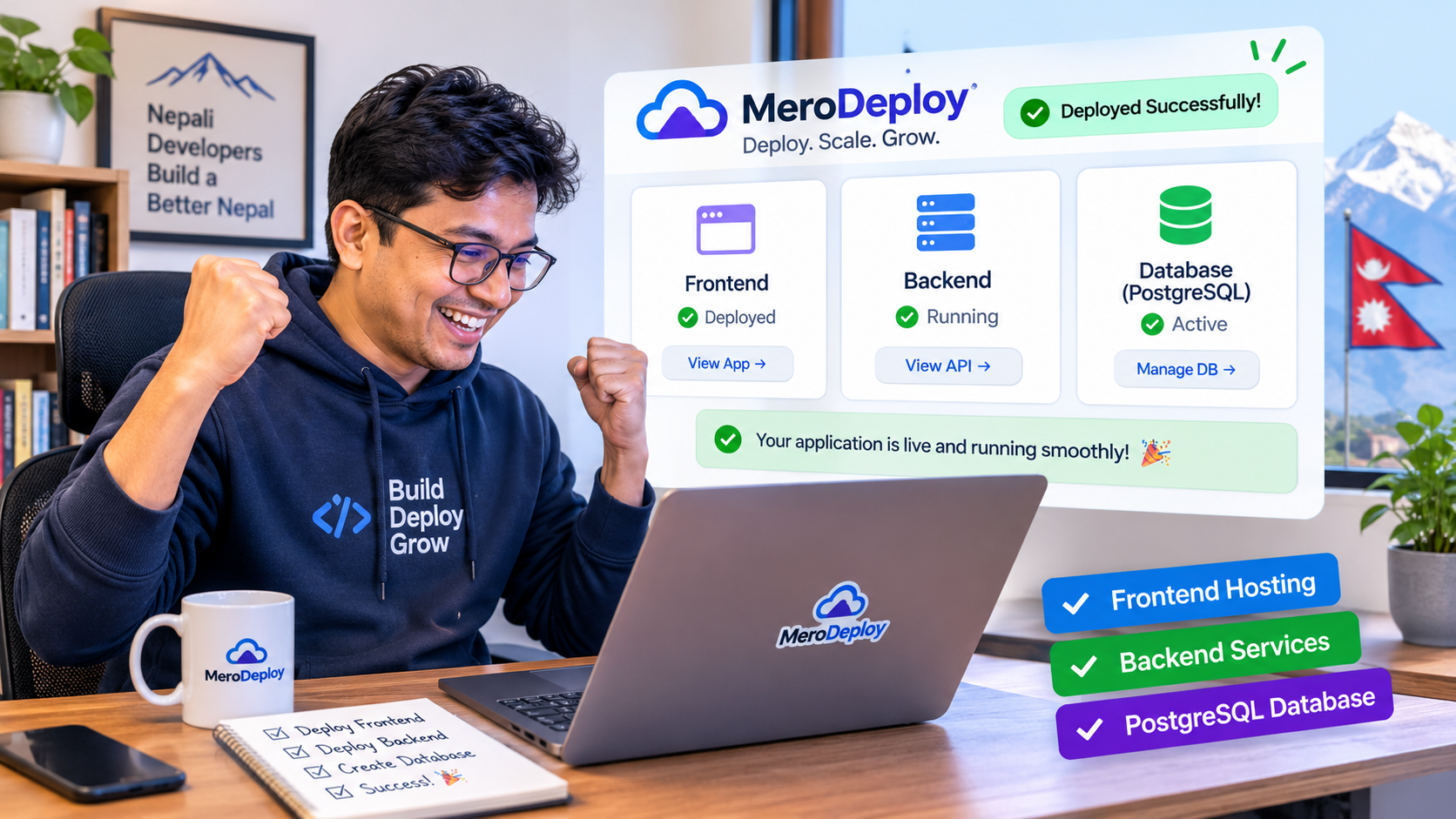
As developers, we spend quite a bit of time looking for the right infrastructure to host our applications. There are plenty of excellent cloud platforms available globally, but finding something that offers a good balance of performance, pricing, and accessibility for applications targeting users in Nepal has always been a bit of a challenge.
Over the years, I’ve experimented with quite a few deployment platforms, including Back4App, Render, Railway, Vercel, and Google Cloud Run.
All of them have their strengths, and I wouldn’t say any of them are bad platforms. However, each comes with its own trade-offs, particularly when you’re building and operating applications that primarily serve users in Nepal.
Recently, I came across MeroDeploy, and after spending some time experimenting with it, I think it deserves attention from Nepali developers.
Here’s why.
My experience with other deployment platforms
Before getting into MeroDeploy, let me explain some of the challenges I’ve experienced with other platforms.
Render
Render is relatively straightforward to use and offers a nice developer experience. However, I’ve found its performance and response times less impressive than I would ideally want for some of my workloads. It is convenient, but speed can become a consideration.
Railway
Railway is another platform I’ve enjoyed working with. Its developer experience is quite good, and deploying applications is relatively painless.
However, when hosting backend services on Railway for applications primarily serving users in Nepal, I’ve noticed latency that isn’t always ideal. Infrastructure location matters, and it becomes particularly noticeable when your users are geographically far from your backend.
Back4App
Back4App has some interesting offerings, but I’ve found upgrading and scaling to be less attractive from a pricing perspective. As your requirements grow, the cost of the plans becomes something you need to consider carefully.
Vercel
Vercel is excellent, particularly for frontend applications and modern web frameworks. It remains one of my preferred choices for the kind of workloads it is designed to handle.
However, depending on what you’re building, you may need additional infrastructure for backend services and databases.
Google Cloud Run
I’ve used Google Cloud Run for quite a few things, and I genuinely appreciate its flexibility and scalability.
But there is a catch: keeping multiple services warm and consistently available can become expensive. When you’re operating several backend services, managing minimum instances and balancing infrastructure costs becomes an ongoing exercise.
For a developer or a small team trying to keep operational costs under control, these trade-offs matter.
Then I found MeroDeploy
After exploring these alternatives for quite some time, I came across MeroDeploy.com.
I decided to give it a try, and so far, the experience has been encouraging.
I’ve deployed a few things on the platform, including a WordPress blog, multiple backend services, and a PostgreSQL database.
One of the things I particularly appreciate is having the ability to host PostgreSQL alongside my application services. Having application hosting and database infrastructure available within the same platform makes experimentation and deployment considerably more convenient.
For my current requirements, it has been working quite well.
A few things I particularly like
1. Pricing that makes sense
Pricing is one of the biggest considerations when you’re building products, especially when you’re experimenting with new ideas or operating smaller applications.
I genuinely like MeroDeploy’s pricing. It feels more accessible for developers who don’t necessarily want to commit to expensive infrastructure just to get their applications running.
2. An incredibly smooth account upgrade experience
This was one of my favourite experiences.
I subscribed to the Starter plan, completed the payment, and my account was upgraded almost immediately.
There was no waiting around for someone to manually review my payment, no need to contact support, and no unnecessary back-and-forth to activate the plan.
It was a small thing, but it made a very good first impression.
As developers, we appreciate platforms that automate these processes and let us get back to building.
3. Very encouraging latency for Nepal
One of the main reasons I wanted to experiment with a Nepal-focused deployment platform was network latency.
So far, I’ve been finding the response times quite good for my testing.
From what I’ve gathered, MeroDeploy’s infrastructure is associated with DataHub Nepal, which makes the local infrastructure aspect particularly interesting.
For applications whose primary audience is in Nepal, having infrastructure closer to the users can make a meaningful difference.
4. PostgreSQL hosting
This deserves a separate mention.
Being able to deploy backend services and have PostgreSQL available on the same platform is genuinely useful.
For developers building applications with FastAPI, Django, Node.js, or other backend frameworks, having access to a familiar relational database without having to manage an entirely separate infrastructure provider is a welcome addition.
5. You can experiment even with the free offering
Another thing I like is that you can get started without immediately committing to a paid subscription.
Even without a paid plan, you can experiment with backend deployments and access your services through their provided endpoints.
Custom domain mapping appears to be one of the features reserved for paid plans, but that doesn’t prevent you from getting a backend service running and testing its API endpoints.
I think this is particularly valuable for students, independent developers, and anyone learning backend development.
You can build something, deploy it, test your APIs, and understand how deployment works without necessarily spending money upfront.
Of course, I’d recommend using the free offering within its intended limits rather than creating multiple accounts to work around plan restrictions.
Why this matters for Nepali developers
I think Nepal has a growing community of developers building products for local and international markets.
However, infrastructure costs can sometimes become a barrier, particularly for students, independent developers, startups, and small software companies.
We have become accustomed to relying on international platforms for almost everything: application hosting, databases, storage, deployment pipelines, and cloud infrastructure.
There’s absolutely nothing wrong with that. These platforms have helped developers worldwide build incredible products.
But having more locally accessible alternatives is a good thing.
Think about a developer building a small SaaS product for Nepali customers. They might not need an elaborate AWS architecture or multiple Google Cloud services. They might simply need:
- A place to deploy their backend.
- A PostgreSQL database.
- A reasonable amount of computing resources.
- Good response times for users in Nepal.
- Predictable and affordable pricing.
- A straightforward deployment experience.
If a platform can provide these things at a reasonable cost, it opens up opportunities for more people to start building.
And that’s something worth appreciating.
Is MeroDeploy ready for production?
I want to be clear that this is not a comprehensive technical review or a long-term reliability assessment.
I’ve been experimenting with MeroDeploy, and my experience so far has been positive. I’m particularly impressed with the pricing, onboarding experience, PostgreSQL availability, and latency I’ve observed.
However, before moving critical production workloads, I’d still recommend evaluating things like:
- Database backup and restoration options.
- Resource limits and scaling capabilities.
- Service availability and uptime.
- Security and network isolation.
- Support responsiveness.
- Data retention and recovery policies.
These are important considerations regardless of which cloud platform you choose.
I’ll continue experimenting with it as I explore more deployment options for my projects.
Final thoughts
I think MeroDeploy is a promising addition to Nepal’s developer ecosystem.
For a long time, we’ve relied heavily on international cloud providers, and while they continue to offer excellent services, having a platform that understands the requirements and economics of the Nepali market is encouraging.
I’m not suggesting that everyone should abandon Render, Railway, Vercel, or Google Cloud. They all have their place, and I will continue using them where they make sense.
But if you’re a developer in Nepal, building something for the Nepali market, or simply looking for an affordable way to get your backend services running, I’d encourage you to take a look at MeroDeploy.
It’s good to see more infrastructure opportunities emerging in Nepal. And even better to see that Nepali developers might finally have another compelling option to build, experiment, and deploy without worrying too much about infrastructure costs.
Explore it yourself: https://merodeploy.com/
Happy building! 🚀
Leave a Reply